TherapyNotes
CSV exports, billing activity, and operational data enter the structured data layer.
DCD Advisory built a governed enterprise environment and custom automation layer that connects practice data, communications, reporting, documents, APIs, and AI-assisted workflows without forcing the practice to replace the systems it already depends on.
CSV exports, billing activity, and operational data enter the structured data layer.
Secure communication and intake workflows connect through API-driven actions.
Governed identities, Drive, Sheets, Docs, Apps Script, enterprise controls, and BAA coverage.
Routing, follow-up, forms, status, and communication workflows.
Exception detection, missing-code checks, and reimbursement review.
Generated summaries, operational reports, files, and recurring documents.
Looker Studio visibility plus AI-assisted analysis and future custom tools.
The goal was not to buy another all-in-one platform. It was to build a secure operating layer around the systems the practice already uses and make the information between them useful.
Critical business and clinical-adjacent operations lived across TherapyNotes, Spruce Health, Google Workspace, CSV exports, spreadsheets, communications, and manual administrative processes. Each platform handled its own job, but the practice needed a secure operational layer connecting the data and workflows between them.
DCD designed a Google Workspace Enterprise environment under a BAA and built a custom automation and data layer around it. Google Apps Script processes TherapyNotes CSV exports, maintains structured operational datasets, generates reports and documents, performs reconciliation and exception logic, and drives recurring workflows. Spruce API integrations connect secure communication and intake processes, while dashboards and AI-assisted tools extend visibility and automation.
Instead of replacing the practice's core systems, DCD turned them into components of a larger connected operating environment. Repetitive administrative work can be automated, problems can be surfaced instead of manually searched for, reports and documents can be generated from structured data, and new workflows can be added as the practice evolves.
Healthcare automation becomes more useful when the data, identities, files, AI tools, and workflow logic live inside a governed enterprise environment from the beginning.
The automation environment is built inside an enterprise Google Workspace tenant operating under a Business Associate Agreement, creating a governed foundation for HIPAA-regulated workflows.
Operational tooling is designed around managed identities, controlled access, governed sharing, and enterprise administration rather than disconnected consumer accounts.
CSV exports, Sheets datasets, generated documents, Drive resources, and downstream reports can follow repeatable handling rules instead of ad hoc local workflows.
AI-assisted workflows can be developed inside the same governed enterprise environment, reducing the need to move sensitive operational work into unmanaged consumer tooling. Covered-service configuration and organizational policy still matter.
Apps Script, structured Sheets data, Drive, Docs, APIs, dashboards, and AI create an extensible toolkit. The same foundation can solve different operational problems without rebuilding everything.
Uploaded billing and operational exports can be parsed, normalized, matched, and transformed into structured datasets for downstream workflows.
Google Apps Script acts as an automation engine for scheduled jobs, business rules, reconciliation logic, file processing, alerts, and workflow state.
Structured Sheet data can feed automatically generated reports, summaries, operational documents, and other reusable outputs.
API calls connect secure communication workflows to the broader operating layer so intake and communication processes can trigger or receive downstream actions.
Forms, routing, communications, document creation, status tracking, and follow-up logic can be coordinated as one repeatable intake workflow.
Expected services and internal tracking can be compared against TherapyNotes billing exports to surface missing codes, unbilled work, and reimbursement exceptions.
Looker Studio and structured reporting layers turn raw operational data into exception-driven views that make issues easier to see and act on.
Once data and workflows are structured, AI can support summarization, classification, drafting, analysis, and new purpose-built tools inside the governed environment.
The public case study uses an illustrative systems view rather than screenshots of production records, patient communications, credentials, or real operational data.
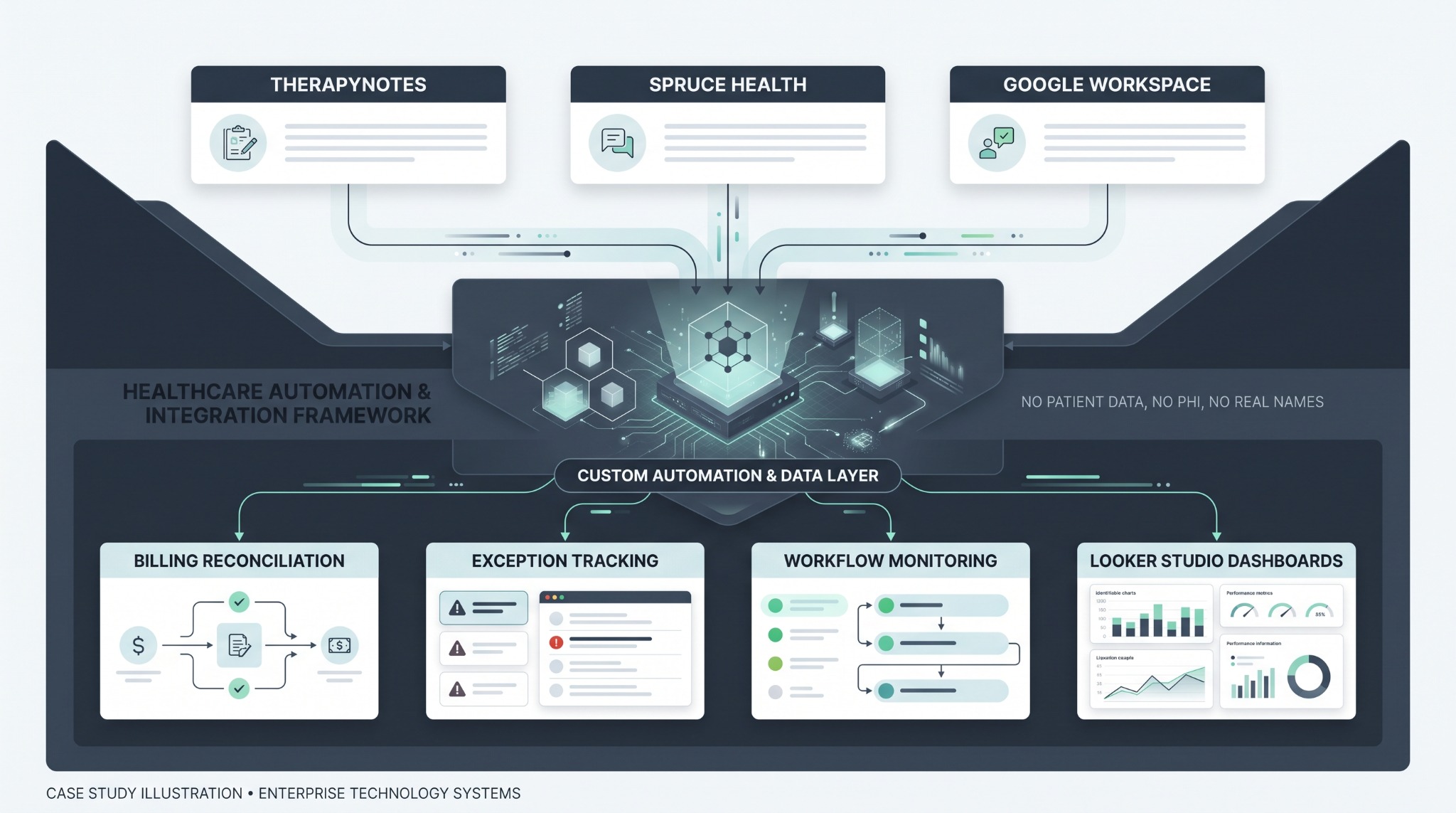
The strategic value is the reusable foundation. New requirements can become additional rules, reports, documents, API calls, dashboards, workflows, or AI tools on top of the same operating layer.
Mindsett's infrastructure is designed so new operational problems can become additional workflows, reports, APIs, dashboards, or AI tools on top of an existing governed foundation instead of starting from zero every time.
DCD Advisory combines creative and technical capabilities around the actual problem - from identity systems and digital experiences to automation, dashboards, AI tools, and custom operational workflows.
The deliverable changes, but the method stays consistent: understand the problem, design the system, build it properly, and connect the pieces that should work together.