DCD Advisory
← Back to Selected Work
Lindsay Clancy Trial Intelligence // Web + Automation + AI & Data

A fast-moving court record turned into a structured intelligence system.

DCD Advisory built a public, source-linked trial archive that combines automated publishing, structured transcripts, evidence organization, analytical scoring, proposition testing, and experimental case intelligence. The larger point is not this one trial: the underlying architecture is reusable anywhere enough reliable source data exists.

Lindsay Clancy Trial source-linked public archive
Project Independent DCD Build
Domain Court + Evidence Intelligence
Current Scale 1,500+ Evidence Records
Capabilities Web + Automation + AI & Data
The assignment

Turn an expanding court record into a living research system.

A court case is not naturally a database. The information arrives as testimony, transcripts, exhibits, dates, documents, expert opinions, and competing interpretations. The build had to preserve those differences while making the record usable.

[01 // Problem]

The record keeps moving.

A live trial produces a rapidly expanding record: daily testimony, transcripts, expert opinions, factual disputes, timelines, medications, exhibits, media coverage, and competing interpretations. The challenge was to make that record searchable, reviewable, updateable, and analytically useful without collapsing it into a single narrative.

[02 // System]

Structure first. Analyze second.

DCD built a Hugo-based public archive with automated daily publishing, structured transcript ingestion, evidence ledgers, source links, medication and timeline data, proposition analysis, Apps Script processing, AI-assisted extraction and classification, and an experimental Case Intelligence layer that can score competing interpretations while retaining contradictory evidence.

[03 // Outcome]

A platform, not a folder.

The result is a living research platform rather than a collection of articles. New source material can flow into structured datasets, trigger downstream processing, update public pages, feed analytical models, and support new tools without rebuilding the foundation each time.

Intelligence pipeline

Source material becomes reusable data.

Each stage creates structure that the next stage can use. That is what allows publishing, automation, analysis, calculation, and future modeling to share one foundation.

DCD Case Intelligence // Processing Architecture Source-linked
[01] INGEST

Acquire

Bring in transcripts, public records, exhibits, structured files, manually reviewed source material, and other available case data.

[02] STRUCTURE

Normalize

Convert inconsistent source material into structured records with dates, people, claims, sources, event types, and other reusable fields.

[03] PROVENANCE

Link

Connect claims back to transcripts and underlying source material so analysis remains auditable rather than detached from the record.

[04] AUTOMATION

Automate

Use Apps Script and repeatable processing workflows to discover new material, publish updates, generate records, and maintain datasets.

[05] ANALYSIS

Analyze

Test evidence against predefined propositions, retain competing interpretations, calculate weighted scores, and surface high-impact records.

[06] WEB

Publish

Turn the structured data into recaps, transcript pages, timelines, dashboards, searchable archives, and public-facing research tools.

[07] MODELING

Model

Build scenario models, trend measures, forecasts, risk indicators, or predictive analyses when the target question and available data justify them.

[08] EXTEND

Extend

Add new factors, calculations, APIs, dashboards, reports, or AI-assisted tools on top of the same data foundation.

Case Intelligence

Competing evidence can be measured without pretending it is a verdict.

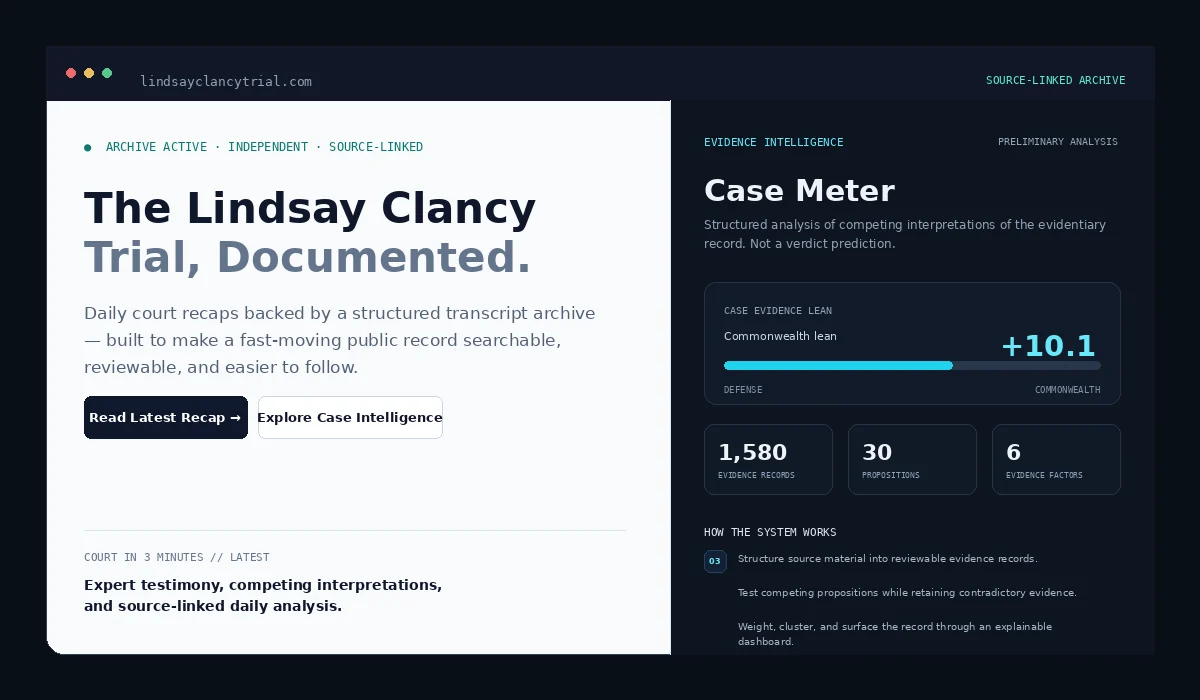
The public Case Meter is an experimental evidence-analysis layer. It uses predefined propositions and analytical factors to organize competing interpretations while retaining contradictory evidence and links back to the record.

Illustrative Lindsay Clancy Trial Case Intelligence dashboard
[01 // Structure]

1,500+ evidence records

The current system converts trial material into structured evidence records carrying source, timing, relevance, strength, and other analysis fields.

[02 // Competing propositions]

30 propositions across six factors

Evidence can support, undermine, contextualize, or be irrelevant to a proposition. The system does not require every record to fit one side's narrative.

[03 // Explainable weighting]

Weight, cluster, compare.

Relevance, strength, timing, corroboration, and clustering rules help reduce simplistic counting and repeated descriptions of the same underlying fact.

Case-agnostic architecture

The engine does not care whether the matter is criminal, civil, or family law.

The domain changes the questions and the rules. The technical pattern stays recognizable: collect reliable records, normalize them, preserve provenance, calculate what can be measured, and build purpose-specific workflows on top.

Evidence intelligence

Criminal Trials

Transcripts, testimony, exhibits, expert opinions, timelines, competing theories, evidentiary factors, and source-linked proposition analysis.

Litigation intelligence

Civil Litigation

Pleadings, discovery, communications, damages records, timelines, deposition material, issue tracking, and scenario analysis.

Financial + record analysis

Divorce + Financial Disputes

Financial records, asset inventories, communications, discovery, motions, orders, settlement proposals, cash-flow modeling, and structured comparison of disputed positions.

Timeline + schedule analysis

Parenting Plans + Custody Records

Calendars, exchanges, communications, school and activity records, orders, schedule history, documented events, and parenting-plan scenario comparisons.

Record intelligence

Administrative + Employment Matters

Policies, correspondence, investigative records, chronology, claims, supporting evidence, hearing material, and repeatable issue analysis.

Case-agnostic architecture

Any Record-Intensive Matter

If a matter has enough reliable source material, the same architecture can ingest it, structure it, connect it, calculate from it, and turn it into usable decision support.

What the same data layer can do

If the data exists, the system can work on it.

The value is not limited to summarizing documents. Once the source material has structure, the same platform can automate workflows, integrate systems, calculate metrics, compare positions, and support more advanced analytical tools.

[01]

Automate

Ingestion, document processing, publishing, report creation, alerts, recurring reviews, and data maintenance.

[02]

Integrate

APIs, spreadsheets, databases, cloud storage, public records, internal systems, and external services can feed or receive structured data.

[03]

Measure

Count, weight, cluster, compare, score, trend, and track facts or behaviors using transparent rules.

[04]

Calculate

Timelines, financial scenarios, schedules, frequency, duration, compliance measures, deltas, and other case-specific calculations.

[05]

Strategize

Organize competing positions, find evidentiary gaps, identify high-impact records, compare scenarios, and support preparation with source-linked outputs.

[06]

Forecast + Model

Build forecasts, scenario models, risk indicators, and predictive analyses where the question is measurable and the available data supports a defensible methodology.

Decision support

Measure what is measurable. Keep judgment visible.

Legal records can support sophisticated analytics, but the model should match the question. Some tasks are deterministic calculations. Others are scenario models. Some may support forecasting or predictive analysis. The methodology, source quality, uncertainty, and limits should remain visible rather than hidden behind a score.

01Automate intake, indexing, updates, reports, and recurring processing
02Connect APIs, databases, spreadsheets, files, and external services
03Measure frequency, duration, timing, consistency, weight, and change
04Calculate timelines, financial scenarios, schedules, deltas, and case-specific metrics
05Compare competing positions and surface evidentiary gaps or high-impact records
06Model scenarios, trends, risks, forecasts, or predictive targets when defensible
The result

The reusable product is the intelligence architecture.

The Lindsay Clancy project demonstrates how a messy legal record can become a structured operating system for research. The same pattern can be adapted to other court cases and private legal matters: ingest the record, preserve provenance, structure the facts, automate repeatable work, calculate what can be measured, model scenarios, and generate outputs that remain tied to the underlying source material.

View Live System Back to Selected Work

Built for problems that do not fit neatly inside a template.

DCD Advisory combines creative and technical capabilities around the actual problem - from identity systems and digital experiences to automation, dashboards, AI tools, and custom operational workflows.

The deliverable changes, but the method stays consistent: understand the problem, design the system, build it properly, and connect the pieces that should work together.

DCD PROJECT DISCOVERY